
What is an NDA and when do you need one?
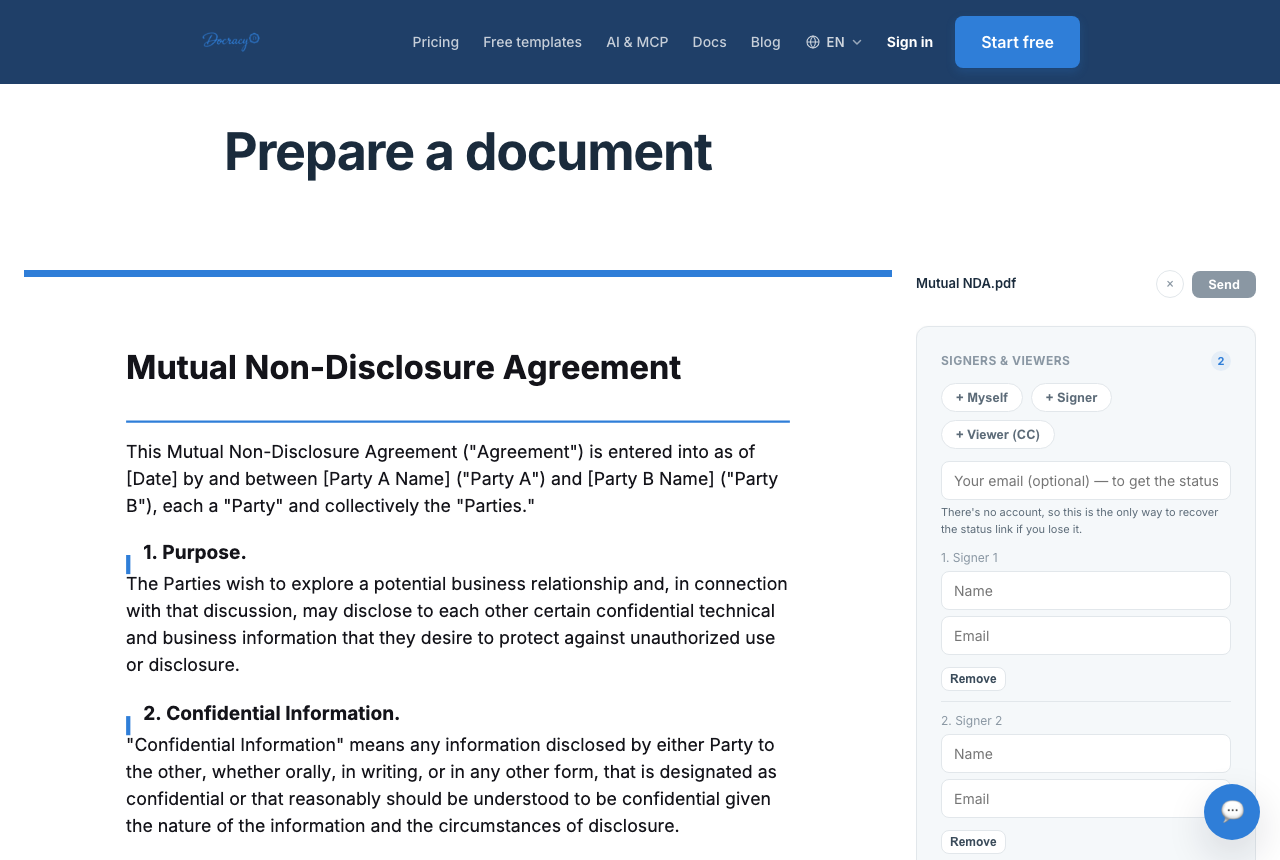

A Non-Disclosure Agreement (NDA) is a simple legal document that prevents someone from sharing confidential information. Businesses use NDAs when working with clients, contractors, freelancers, or partners. The goal is always the same: protect sensitive data before it's shared, not after it's already out.
You don't need a lawyer to send a reasonable NDA for most everyday situations — a freelancer signing before a discovery call, two small businesses comparing notes on a potential partnership, a contractor getting a look at internal pricing before a quote. What matters more than legal polish is that the document actually gets signed before the sensitive conversation happens, not after.
The two types of NDA
NDAs come in two shapes, and picking the wrong one is a common early mistake:
- One-way NDA: only one party shares confidential information — typical when a business briefs a freelancer or vendor on internal details.
- Mutual NDA: both parties share sensitive information — typical when two companies explore a partnership, merger, or joint project.
Read more: one-way vs. mutual NDA
What a solid NDA actually covers
Beyond the boilerplate, a well-written NDA answers four specific questions:
- What information is confidential — vague language here ("any information disclosed") is the single most common weak point
- How the information may be used — for evaluating a deal, not for competing with it
- How long confidentiality lasts — most run 1–3 years for business information, longer for trade secrets
- What happens if someone breaks the agreement — even a plain statement that damages are hard to quantify can matter later
A concrete example
Say a startup founder wants to brief a freelance product designer on an unreleased feature before deciding whether to bring them onto the project. The founder isn't sharing source code or financials — just a roadmap document and a few early screens. A tightly scoped one-way NDA for that situation would name the founder's company as the disclosing party, list "unreleased product designs and roadmap materials" as the protected information instead of a vague catch-all, set a one-year confidentiality term, and explicitly exclude information the designer already knew or that becomes public through no fault of theirs.
Notice what that example doesn't do: it doesn't try to cover every possible category of information "just in case," and it doesn't leave the term open-ended. Specific and time-bound is what actually holds up when someone has to point back to the document months later.
Where NDAs show up
- Freelance projects
- Software development
- Partnerships
- Hiring processes
- Product launches
A useful rule of thumb: if you'd be uncomfortable seeing the information you're about to share end up in a competitor's hands, get the NDA signed first — not after the meeting, when it's already too late.
When you probably don't need one
Not every conversation needs an NDA, and sending one reflexively can create friction where none is warranted. A 15-minute intro call to see if there's mutual interest in working together, a conversation limited to information that's already public, or an exchange of ideas so generic that a dozen other people could have come up with the same thing — none of these need a signed agreement first. Save the NDA for the moment actual specifics are about to change hands: a real roadmap, real numbers, real client names.
Signing an NDA online
Signing an NDA online is fast and legally valid in most jurisdictions under e-signature laws like ESIGN and eIDAS. Docracy lets you send an NDA without asking the other party to create an account first, which matters most in exactly the situations NDAs come up in — a first call, a cold intro, a deal that might not go anywhere. Nobody wants to sign up for software before they've even decided to work together.
Sending a document with two or fewer signers is free — most one-way and mutual NDAs only ever need the two parties, so this covers the typical case without a subscription. Every signed document also comes with a timestamped audit trail showing when it was delivered, opened, and signed, plus a SHA-256 hash of the final PDF so you can prove later that the file hasn't been altered.
See the full step-by-step flow
Free mutual NDA template — sign online
NDA signing page — send in minutes
NDAs compared to other documents
An NDA is often confused with two other things it isn't. It's not the same as a non-compete: an NDA restricts what someone can say, a non-compete restricts where they can work afterward. They're sometimes signed together, but they do different jobs, and many jurisdictions treat non-competes far more skeptically than NDAs. An NDA is also not the same as a confidentiality clause buried inside a larger contract — that can work fine, but a standalone NDA is easier to reference on its own and easier to get signed before the rest of a deal is finalized.
Frequently asked questions
Do NDAs expire?
Usually, yes — most NDAs specify a term for how long confidentiality obligations last, commonly one to three years, though trade secrets are sometimes protected indefinitely. An NDA with no expiration date at all is a red flag worth reading closely before signing.
One-way or mutual — which one do I need?
It depends on which direction the sensitive information flows. If only one side is disclosing anything, a one-way NDA is simpler and clearer. If both sides are sharing information they'd rather not see repeated elsewhere, a mutual NDA protects both of you under the same terms.
Full breakdown: one-way vs mutual NDA
Can I just use a free template, or do I need a lawyer?
For most everyday situations, a free template is enough — Docracy's Marketplace has more than 97 free templates, including one-way and mutual NDAs, that cover the common cases without any drafting. A lawyer is worth involving when the stakes are unusually high: large trade secrets, cross-border deals, or anything where the definition of "confidential" needs to hold up under real scrutiny.
What's the most common reason an NDA fails to protect someone?
Vague drafting, not bad luck — a definition of confidential information so broad it's unenforceable, or a missing expiration date that makes the whole agreement harder to argue about later.
Send an NDA now — free mutual NDA template
Why teams start with Docracy
“Docracy is a great product that I have tested and am using. It is easy to use, has good tools, is always up to date, and implements new features. Highly recommended.”— DACH Advisory


Also: Compare e-sign pricing · Free mutual NDA template
No account required for up to 2 signers.