
What is a service agreement?
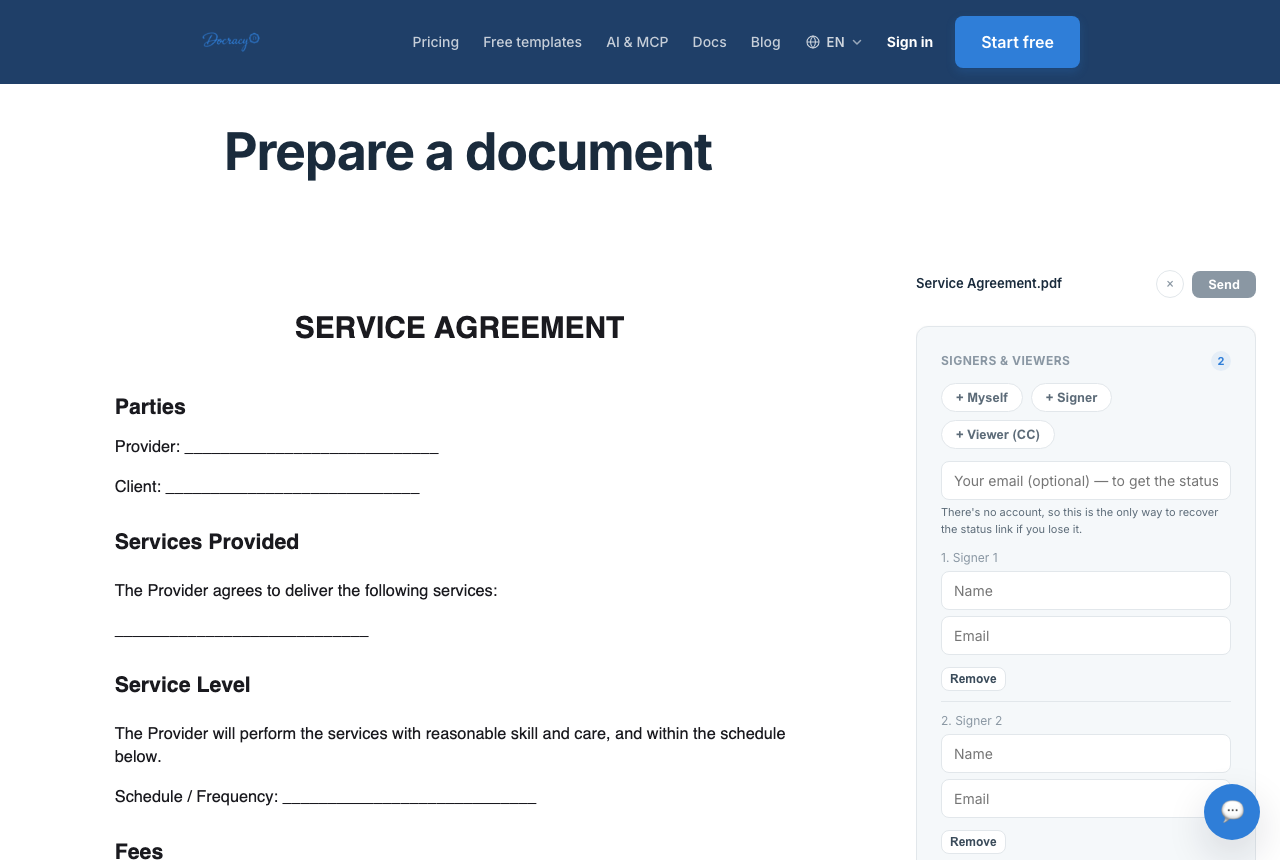

A service agreement defines what service is delivered, how, when, and at what cost. It protects both provider and client by turning a verbal understanding — "I'll handle your social media" — into something specific enough that either side could point to it later and say exactly what was agreed.
What a service agreement typically covers
- The service itself — described specifically enough to avoid two different interpretations
- Delivery method and schedule — ongoing retainer, project-based, or recurring
- Cost and payment terms — flat fee, hourly, or milestone-based
- Duration and renewal — a fixed term, or ongoing until either side cancels
Service agreement vs. a simple contract
The two overlap a lot, but a service agreement usually implies an ongoing or recurring relationship — a monthly retainer, a subscription-style service — rather than a single one-off deliverable. If the work is genuinely a single project with a clear end, a simpler one-off contract often fits better, since it doesn't need renewal or cancellation language at all.
Retainer vs. subscription vs. project: what's actually different
The term "service agreement" covers three fairly different arrangements, and mixing them up in the contract language is a common source of confusion. A retainer is a pre-paid block of time or availability — a client pays, say, $2,000 a month for up to 20 hours of work, with unused hours either rolling over or expiring depending on what the agreement says. A subscription is a flat recurring fee for access to a defined service or output regardless of exact hours worked — a monthly fee for ongoing website maintenance, where the provider handles whatever comes up rather than tracking hours against a cap. A project-based engagement, by contrast, is a single deliverable with a defined end, even if it's billed in installments. Retainers and subscriptions are the two forms a service agreement is really built for; a one-off project is usually better served by a simpler contract.
Structuring a monthly retainer well
A retainer agreement earns its keep by answering three questions clearly: how many hours or how much output is included each month, what happens to hours that go unused (rolling over for a limited window is common; expiring at month's end is simpler to administer), and what the rate is for work beyond the included amount. Leaving any of these vague is what turns a retainer into a recurring argument — the client assumes unused hours roll over indefinitely, the provider assumes they don't, and neither finds out until month three.
Renewal and cancellation terms
Recurring service agreements commonly auto-renew — a monthly agreement rolls into the next month automatically unless either side cancels. That's a convenience, not a trap, as long as the notice period is stated clearly: 30 days' written notice before the next renewal is a common default, long enough that a client isn't billed for a month they didn't intend to keep. State the notice period as a specific number of days rather than "reasonable notice," and specify how notice is given — an email to a stated address is usually sufficient and simplest to prove later.
A clause worth including: what happens if the service changes
Services evolve — a client wants more hours, a provider changes their process. A short clause describing how changes get agreed on, such as an email confirmation or a signed addendum, saves a lot of "wait, when did we agree to that?" later.
Frequently asked questions
Should a retainer have a minimum commitment period?
Many do — a three-month minimum is common, giving both sides enough runway to see if the relationship works before either can walk away. It's not required, but a retainer with no minimum term is functionally month-to-month, which is worth deciding on purpose rather than by default.
Who usually drafts the service agreement?
Typically the provider, since they're describing their own service — but either side can propose one, and starting from a clear template speeds this up regardless of who writes the first draft.
Free service agreement template
Why teams start with Docracy
“Docracy is a great product that I have tested and am using. It is easy to use, has good tools, is always up to date, and implements new features. Highly recommended.”— DACH Advisory


Also: Compare e-sign pricing · Free mutual NDA template
No account required for up to 2 signers.