
How freelancers onboard clients quickly
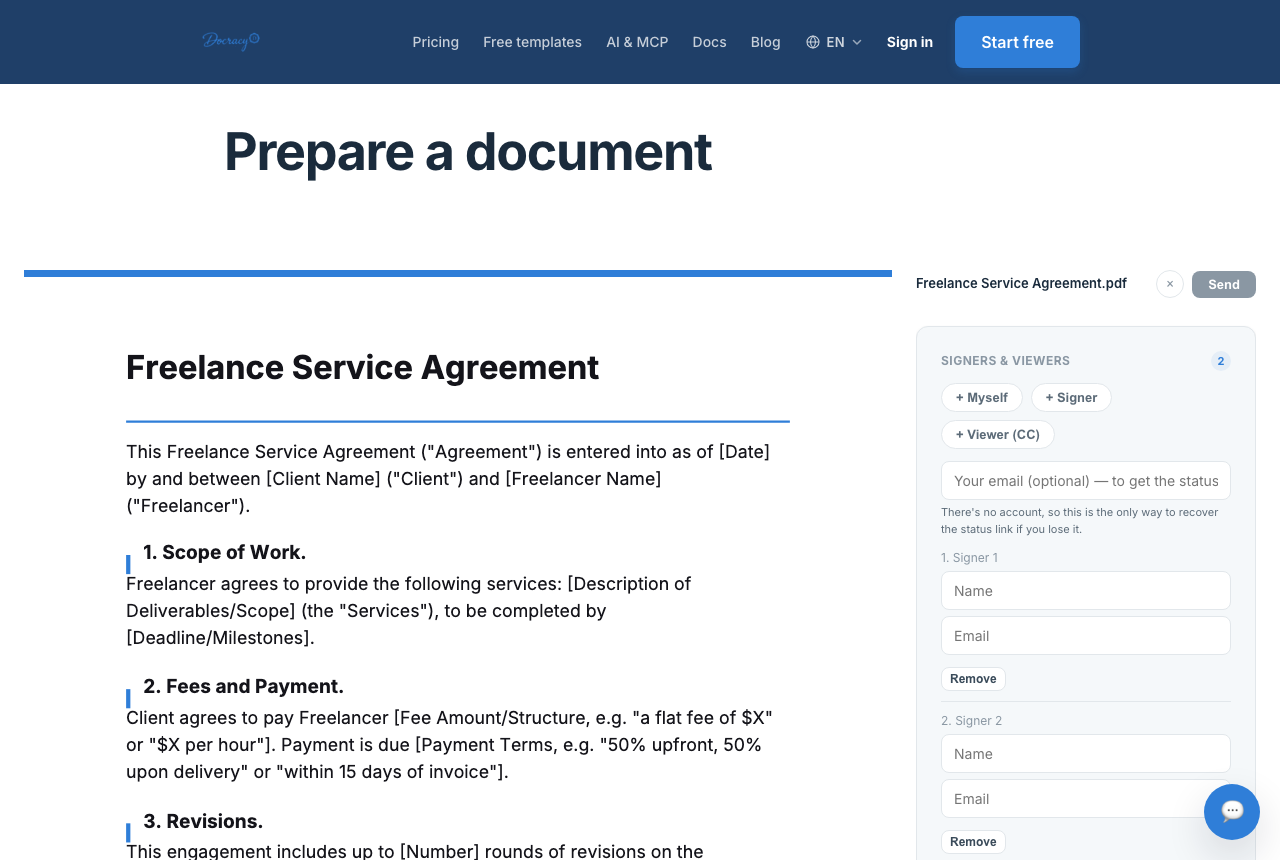

The gap between "a client says yes" and "work actually starts" is where a lot of freelance momentum gets lost. A fast, repeatable onboarding sequence keeps that gap short: send NDA → send contract → send invoice → start work.
The four-step sequence
- Send an NDA — if the project involves any confidential information, get this signed before the real conversation happens
- Send the contract — scope, timeline, and payment terms, so both sides start from the same understanding
- Send the invoice or deposit request — get payment terms confirmed before work begins, not after
- Start work — once everything's signed and the deposit (if any) has cleared
Why order matters here
Doing these out of order is where onboarding usually breaks down — starting work before the contract is signed, or sending an invoice before scope is actually agreed on. Each step depends on the one before it: the contract references terms the NDA already covers, and the invoice reflects what the contract actually promises.
What to automate before you need it
Speed here doesn't come from rushing through each step — it comes from removing the parts that don't need a human decision each time. A few things are worth setting up once so they're not rebuilt for every new client:
- A saved contract and NDA template with your standard terms already filled in, leaving only client name, project details, and price to update
- A fixed signer order — NDA first, contract second — so the sequence enforces itself instead of relying on you to remember it
- A standard payment schedule (for example, 50% deposit, 50% on delivery) that's the default unless a specific project calls for something else
- A short intake form or questionnaire sent alongside the contract, so project details you'd otherwise chase down over email arrive upfront instead
None of this requires anything exotic — Docracy's field auto-detect can place standard signature and date fields on an uploaded contract automatically, and a saved template means the next new client only requires filling in what's actually different about that engagement.
What belongs in an onboarding packet
A strong onboarding packet is less about the number of documents and more about giving a new client everything they need in one pass, rather than in five separate follow-up emails. A reasonably complete packet includes: the NDA (if applicable), the signed contract, an attached scope of work spelling out deliverables and revision limits, the invoice or deposit request, and a short kickoff note covering how you communicate (email, a project tool, response-time expectations) and what the client needs to provide before work can start (assets, access, feedback deadlines). Sending all of this together, rather than trickling it out, is what actually makes onboarding feel fast from the client's side — even if the underlying documents took you five minutes to prepare from a template.
Timing benchmarks worth aiming for
There's no universal standard, but a few rough benchmarks separate onboarding that feels fast from onboarding that lets a prospect's interest cool off: an NDA out within the same conversation or within an hour of a client asking for one; a contract out within 24 hours of scope being agreed, ideally the same day; an invoice or deposit request sent the moment the contract is signed, not after a follow-up email; and work starting as soon as the deposit clears — which, depending on payment method, can be instant or take a few business days, so it's worth stating that expectation upfront rather than leaving the client guessing.
Making it fast without cutting corners
Speed here comes from having reusable templates ready, not from skipping steps. An NDA and contract you've already drafted once, with the specific client details swapped in each time, can go out within minutes of a client saying yes — which matters, since momentum fades fast once a prospect starts waiting.
Frequently asked questions
Can the NDA and contract be combined into one document?
Sometimes, for very simple engagements — but keeping them separate is usually cleaner, especially if the NDA needs to survive even if the contract itself ends or is renegotiated.
Should the deposit be required before or after the contract is signed?
After. A deposit tied to a signed contract is far easier to justify and collect than one requested before either side has formally agreed to anything.
How fast is realistically achievable for a first-time client?
With templates ready, same-day onboarding — NDA, contract, and invoice all out within a few hours of a client agreeing to move forward — is a reasonable target. What usually slows it down isn't the paperwork itself, it's waiting on the client to review and sign, which a clear, short document makes easier to do quickly.
What if a client wants to start before anything is signed?
It's worth resisting, even for a trusted-feeling new client — this is precisely the scenario contracts exist for. A same-day contract turnaround removes most of the client's reason to ask, since there's little practical delay being avoided by skipping it.
Why teams start with Docracy
“Docracy is a great product that I have tested and am using. It is easy to use, has good tools, is always up to date, and implements new features. Highly recommended.”— DACH Advisory


Also: Compare e-sign pricing · Free mutual NDA template
No account required for up to 2 signers.